anavi.
Menu

How Anavi investigates.

Explore the models, comparisons and evidence behind the work.

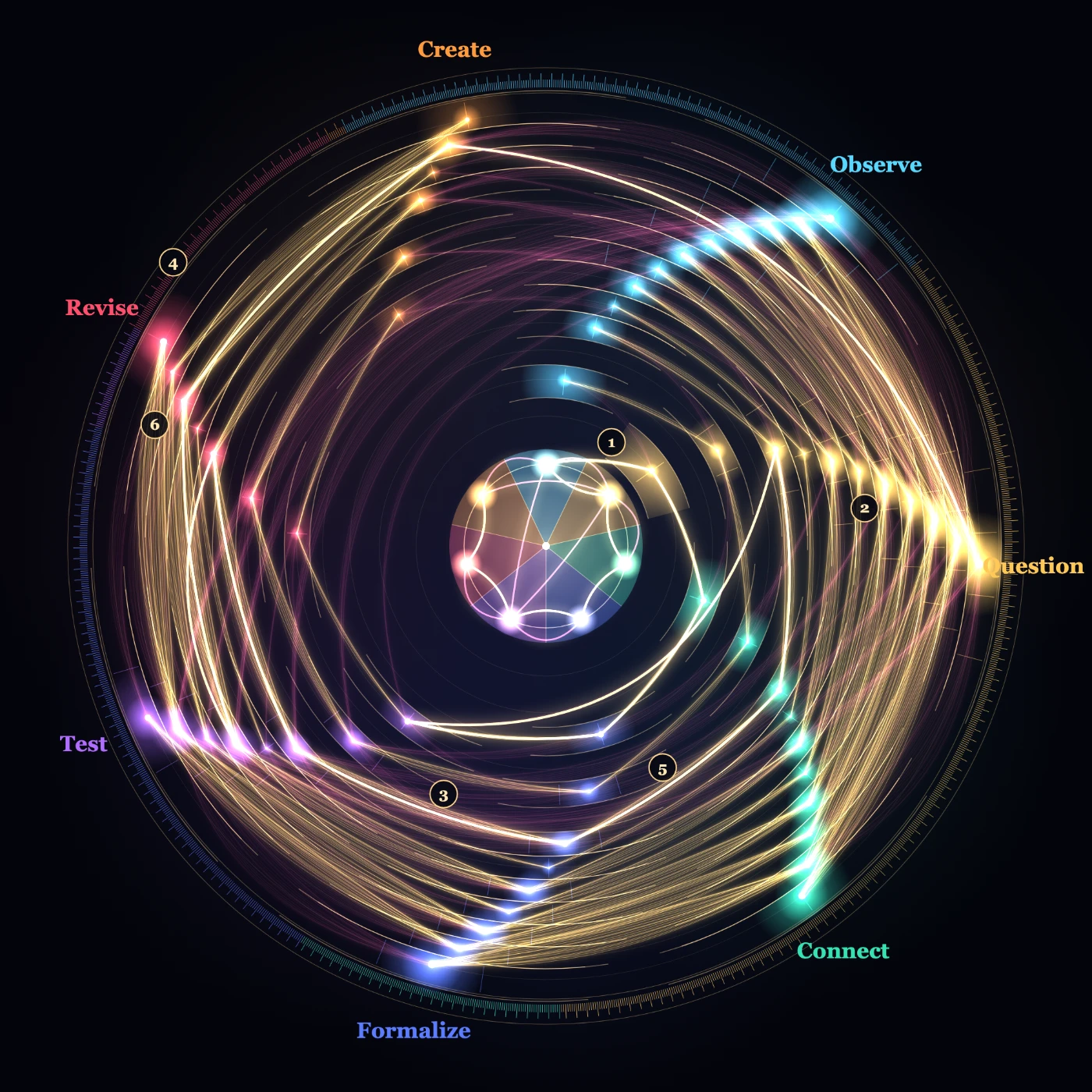
Illustration: a luminous rose of every path an inquiry can take through Anavi’s seven moves. At its centre, the seven moves and their 14 allowed next moves; 13 rings outward hold the paths of one to 13 moves, brighter where more paths arrive; gold strands follow moves forward and rose strands the 8 that return; one bright gold thread traces a single inquiry; the rim carries 1,370 ticks, one per 13-move path. Numbered markers 1 to 6 match the key.

One question. Many possible paths. Seven inquiry actions and fourteen allowed transitions shape this drawing. Follow one inquiry through its central graph; the outer rings remain the complete static map.

The illustrated inquiry returns to Question after thirteen moves. Read its complete path and all six mathematical references below; motion is never required.

Six references connect the visible construction to its mathematics.

Read the artwork — its six references and complete path

Ring k holds the inquiries of k moves from Observe: Nk(v) = (eO⊤Ak)v of them stand at move v. The rim counts all 1,370 inquiries of 13 moves. The key to markers ① to ⑥

How the drawing is built

Illustration An exact construction from the movement, Anavi’s design formalization of how it works on a question. It counts what the movement allows; it does not measure Anavi’s work, and it shows no product behaviour.

  1. ① The movement as a graph. G = (V, E), |V| = 7, |E| = 14; Auv = 1 when v may follow u. The centre: the seven moves and their fourteen allowed next moves, as “The movement as text” lists them.
  2. ② Paths of k moves. Nk(v) = (eO⊤Ak)v: how many different k-move inquiries from Observe stand at v. Ring k, node v glows with radius 8 + 6 log2(1 + Nk(v)). At ②, N9(Question) = 47.
  3. ③ Every path may take every allowed move. Nk+1(v) = Σu→v Nk(u). Each move u → v at step k is drawn as 1 + ⌊2.2 log2(1 + Nk(u))⌋ strands. At ③, Formalize → Test after 7 moves carries N7(Formalize) = 9 paths.
  4. ④ The frontier. Σv N13(v) = 1,370: one rim tick per 13-move inquiry, grouped by where it ends. The totals 1, 1, 2, 3, 5, 10, 16, 35, 55, 120, 190, 406, 656, 1,370 grow like λk, with λ = ρ(A) ≈ 1.8471, the largest root of x7 − 4x5 + 3x3 − x2 − x − 1 (Perron–Frobenius: G is strongly connected, with cycles of length 2 and 5).
  5. ⑤ Returns. 8 of the 14 moves go back to an earlier move (rose), such as Test → Question: “A failed hypothesis returns to Question.” At ⑤, after 8 moves, N8(Test) = 13 paths can return this way.
  6. ⑥ One inquiry. The gold thread is the path this site’s “Show one path” plays: Observe → Question → Connect → Formalize → Test → Question → Connect → Formalize → Test → Revise → Test → Revise → Create → Question.

Authored, not computed: the rings’ radii and gentle twist, the colours, the glow and the frame.

The moving light follows the same thirteen allowed moves as the illustrated inquiry. Its central guide curves and timing are authored, not recovered coordinates from the original raster generator or measurements of Anavi’s work. The original drawing remains the static map. Previous and Next expose the same states without animation.

One inquiry, with its returns

Start at Observe: one zero-move path. The counts below describe all allowed paths from Observe, not just this single illustrated inquiry.

  1. Observe → Question. Something does not fit. A question forms. 1 of the 1 allowed 1-move paths end at Question.
  2. Question → Connect. Another field may already have a name for this structure. 1 of the 2 allowed 2-move paths end at Connect.
  3. Connect → Formalize. Say exactly what corresponds to what. 1 of the 3 allowed 3-move paths end at Formalize.
  4. Formalize → Test. A precise claim can be tested. 1 of the 5 allowed 4-move paths end at Test.
  5. Test → Question. A failed hypothesis returns to Question. 5 of the 10 allowed 5-move paths end at Question.
  6. Question → Connect. Another field may already have a name for this structure. 5 of the 16 allowed 6-move paths end at Connect.
  7. Connect → Formalize. Say exactly what corresponds to what. 9 of the 35 allowed 7-move paths end at Formalize.
  8. Formalize → Test. A precise claim can be tested. 13 of the 55 allowed 8-move paths end at Test.
  9. Test → Revise. It partly holds. Revise what it claims. 13 of the 120 allowed 9-move paths end at Revise.
  10. Revise → Test. Test the revision. 41 of the 190 allowed 10-move paths end at Test.
  11. Test → Revise. It partly holds. Revise what it claims. 41 of the 406 allowed 11-move paths end at Revise.
  12. Revise → Create. What survives takes a form. 41 of the 656 allowed 12-move paths end at Create.
  13. Create → Question. Making it generates another question. 478 of the 1,370 allowed 13-move paths end at Question.

I Purpose

Anavi

Anavi LLC

Anavi investigates structure across systems, disciplines and scales—testing what survives translation, where the resemblance breaks, and what becomes possible when useful connections are made rigorous.

It begins with questions. It looks across boundaries without pretending the boundaries are meaningless. It tests correspondences against evidence and against difference, revises when they fail, and creates when something useful takes shape.

What takes shape may be research, a model, an experiment, a method, a tool, a visualization, software or a product. None of these is the boundary of the company.

How Anavi thinks: from a question to a possibility

A question.

A question often crosses disciplines before it belongs to any of them—before it becomes a research question, a model, an experiment or something to build. What happens next is not a pipeline.

The movement: Observe · Question · Connect · Formalize · Test · Revise · Create. A ribbon joins the moves an inquiry can make; you choose where it goes. Test can send it back to Question or to Observe, and Create can open another question.
The movement as text
  1. Observe — Look closely at what is there, including what does not fit.
    • → Question: Something does not fit. A question forms.
  2. Question — Say what you do not understand, precisely enough to pursue it.
    • → Connect: Another field may already have a name for this structure.
    • → Observe: The question is not sharp yet. Look again.
  3. Connect — Look across boundaries for a structure that might answer it.
    • → Formalize: Say exactly what corresponds to what.
    • → Question: The resemblance is only on the surface. Ask again.
  4. Formalize — State the connection exactly enough to be wrong.
    • → Test: A precise claim can be tested.
  5. Test — Put it against evidence, including the case most likely to break it.
    • → Formalize: The test exposes an ambiguity. Sharpen the statement.
    • → Question: A failed hypothesis returns to Question.
    • → Observe: A discovered relationship returns to Observe.
    • → Revise: It partly holds. Revise what it claims.
  6. Revise — Change the claim, the model or the method, and keep the record of why.
    • → Test: Test the revision.
    • → Create: What survives takes a form.
  7. Create — Give what survives a form: a model, a method, a tool, a piece of writing, software.
    • → Question: Making it generates another question.
    • → Observe: Put it into the world, and watch what it does.

Possibility.

What survives takes a form—one possibility among others, and the start of the next question.

I’m Ash.

Founder · AI product builder · Independent researcher

I’m Ash, founder of Anavi, an MBA candidate at Seattle University Albers School of Business and Economics, and a female veteran with a background in United States military intelligence. I earned my Bachelor of Science in Neuropsychology from Portland State University. I’m also a polyglot and an avid, many-faceted nerd, drawn to the connections between minds, languages, stories, science and systems.

More about Ash: the whole biography, questions and selected work →

II Projects

One thing that took shape.

Folium X

A question about what a personal library could become is developing into a higher-order system for books, evidence, interpretation and inquiry.

In development; not release-ready.

Folium X formalization: three expressions from its own framework

  • Work≠Edition≠Copy

    Folium X is designed to keep a work, an edition of it and the copy on your shelf apart, and to give your copy its own history.

    Design formalization in Anavi’s legend Folium X’s label: Design principle

  • G=(V,E)

    The library as a graph. V is the set of vertices—books, passages, people and questions—and E the set of edges, the typed relations among them. E never stands for Edition, which is always written in full.

    Design formalization in Anavi’s legend Folium X’s label: Structural correspondence

  • Φ(ℒt,xt,Ct)=ℒt+1

    Φ, a constrained transformation: it takes the library’s state at one step, an input, and the constraints that apply at that step—such as provenance, identity, permissions, source fidelity, privacy, reader authority and epistemic status—and gives the state at the next step. An input that meets the constraints is applied; one that does not is refused, and the state is unchanged except for a record of the refusal. The principle that what must stay traceable stays traceable applies only to such admissible transitions, under their stated constraints, and to the claims that survive them uncorrected and undeleted—not to arbitrary updates.

    Design formalization in Anavi’s legend Folium X’s label: Design principle

Defined in Folium X’s own framework, where it is canonical. It describes one product: it is not a model of Anavi, and Anavi’s other work does not inherit it. Each expression carries two labels that answer different questions. Anavi’s label says what kind of company claim it is: here, always a design formalization, our model of our own product. Folium X’s label says which particular claim Folium X makes with that expression. Neither is a confidence score, and there is no automatic mapping from one to the other. Its Φ is Folium X’s own symbol; it is not the standard normal cumulative distribution function Φ used in The discipline.

Project stories

The ideas you keep returning to

App · In development; not release-ready

Folium X

“What have I been thinking about all year without noticing?”

Asked by you, of the books you actually own and read.

The intended experience

A passage can change the way you read another book—and the way you understand your own life. Folium X is being built to follow those exchanges across your collection: recurring preoccupations, unexpected affinities, convictions brought into question, and ideas that become something of your own.

Proof, gathered

App · Pilot built, not yet released

ScopeWitness

What exactly did we agree to, and can we show it’s done?

The intended experience

Give an agreement a visible record of fulfilment: photographs, notes and sign-off connected to the work promised, so a customer can see what was done and a team can account for it.

The pass at 7:40

App · Pilot built, not yet released

PassSignal

Did everyone on the floor hear that the salmon is gone?

The intended experience

A busy service depends on a shared understanding of what has changed. Carry each update to the people who need it, and make their acknowledgement visible while there is still time to act.

A word and its world

App · Early prototype

Ancient Hebrew World

What could this word mean in its own time and place?

The intended experience

Encounter a word within the world that gave it meaning: its textual surroundings, material life and interpretive questions. Follow the evidence into a study whose connections you can examine and make your own.

III Research and principles

What survives translation?

Different systems often share structures that disciplines name differently. Take two that seem unrelated—an ecosystem and an information network—and one structure that appears in both: feedback.

The comparison as a table
Prey at the startPrey over the cycleWindow at the startWindow after the first loss
1.50.63 to 1.50620 to 40
2.00.41 to 2.002020 to 40
3.00.18 to 3.003420 to 40
Prey population in the classical predator–prey model (units of its balance point; α = β = γ = δ = 1, predators starting at balance) and a sender’s window in a single-flow congestion model (a link that loses packets at 40 in flight). Matched: each curve scaled to its own peak (for the window, the link’s capacity) and drawn over its own time span—24 units of model time, 100 round trips—then overlaid. Broken: each on its own axis, from the starting point you choose.

The correspondence What genuinely matches.

  • Both are negative feedback loops. More prey feeds more predators, and more predators leave fewer prey. More sending fills the link’s queue, packets are lost, and the sender halves its window. Established within each field
  • Both oscillate: a rise, a correction, a fall, a recovery. Established for each model
  • The shared shape—a quantity pushed back by the consequences of its own growth—is real. Structural analogue

Predator and prey (Lotka 1925; Volterra 1926)

dxdt=αx−βxydydt=δxy−γy

x is the prey population and y the predators; α is the prey’s growth rate, β the rate of predation, δ the rate at which meals become predators, γ the predators’ death rate.

Additive increase, multiplicative decrease (Jacobson 1988; Chiu & Jain 1989)

each round trip:w←w+1on a loss:w←w/2

w is the congestion window: how much a sender may have in flight before hearing back. A loss is read as a signal that the path is full. The figure follows one sender. Chiu & Jain’s result concerns several senders sharing a link, under their model’s assumptions—among them, one bit of feedback that reaches every sender at once; there, additive increase with multiplicative decrease converges to an efficient, fair share.

The difference Where it breaks.

And then it broke

But here the analogy fails.

Start the two systems from different places. The network returns to the same rhythm: after its first loss, the window swings between half the link’s capacity and all of it, from any whole-number start up to the capacity. Other starts can differ: from 2.3, the peaks after the first loss are 40.15, 40.075, …, and from 41 they are 40.5, 40.25, …; each overshoots the capacity by half the previous overshoot, so the window approaches that swing without ever reaching it exactly. The predator–prey cycle does not return: each starting point keeps its own cycle, larger or smaller, for ever.

V(x,y)=δx−γln⁡x+βy−αln⁡y

V stays constant along every cycle of the classical model, so nothing pulls a cycle back to a standard size: its size is fixed by where it started. Established for the classical model

  • No one designed the ecosystem’s rule. The network’s rule was designed: engineers chose it after the Internet’s first congestion collapse, in October 1986 (Jacobson 1988). No one chose the rates at which rabbits are born or foxes starve, or any limit that holds them in check. Established
  • The signal differs. In these two models, the sender reads loss as a designed signal about the path and responds by a rule, while predators and prey meet only through encounters, meals, births and deaths. Established for these two models
  • Failure differs. A network rule that misbehaves can be rewritten. An ecosystem under gradual pressure can switch suddenly to a contrasting state, and may not return when the pressure eases (Scheffer et al. 2001). Established

The difference is information too.

In these two models, and from the starts tested here, the break has a cause you can name. The predator–prey cycle keeps the size it began with because V is conserved; the window returns to the same band from each start because the link loses packets at the same point every time and the rule halves the window at each loss. That is not a general test. A cycle whose size depends on where it started does not, by that alone, have a conserved quantity, and a cycle that returns to one size from anywhere shows neither that someone designed it nor which mechanism brings it back. The failed analogy leaves a question to ask of the next system: what brings it back, if anything, and did anyone choose that?

Which model you translate matters. Give the prey a limit to their growth and the predators a limit to their appetite (Rosenzweig & MacArthur 1963), and the ecological model can settle into a cycle of fixed size too, with no designer: essentially every predator–prey model proposed by 1972 has either a stable equilibrium or a stable cycle (May 1972). The first break belongs to the classical model; the differences in design, signal and failure survive this refinement. Established

Tested here: “an ecosystem regulates itself the way congestion control does.” Speculative analogy It fails, and the failure is kept.

Recurring structures

Some structures recur across apparently different systems. Choose one to see the domains where we record a claim about it, and what kind of claim each is. This is an index of places to look, not a checklist imposed on reality: where a structure is not drawn, no claim is made. Sources are named beside the entries they support; an entry without one is a definition, a standard result or method of its field, or a comparison of our own.

The constellation: twelve structures on the inner orbit, ten domains on the outer. A line appears only where a claim about that structure in that domain is recorded; its pattern names the kind of claim. Choose a domain to see every structure it carries.
The constellation as text
  1. Feedback — Outputs or consequences return as later inputs. Where it stops: A loop drawn on a diagram is not yet a control system: say what is measured, what responds, and how.
    • Mathematics: Control theory: a controller measures the gap between a system’s output and a target and acts to reduce it. Established
    • Computation: Congestion control: a sender halves its window when packets are lost and grows it slowly otherwise (the translation above). Established
    • Biology: Blood glucose: insulin lowers it, and falling glucose reduces the release of insulin (Röder et al. 2016). Established
    • Cognition: Reaching for a cup: the movement is updated as it unfolds, from what the eyes and body report and from the brain’s prediction of where the arm will be (Desmurget & Grafton 2000). Established
    • Organizations: A review that changes the process that produced the work, not only the work (double-loop learning: Argyris & Schön 1978). Structural analogue
    • Design: Prototype, test, change the next prototype: feedback carried by people rather than by a signal. Structural analogue
  2. Recursion — A process or definition applied to its own results. Where it stops: Repetition is not recursion: recursion needs a process applied to its own output or structure.
    • Mathematics: A recursive definition: n! = n × (n − 1)!, with 0! = 1. Established
    • Computation: A procedure that calls itself on smaller parts of a problem; data such as trees, whose parts are trees. Established
    • Language: Clauses inside clauses: “the book that the friend who visited left.” English allows such embedding; whether every language does is disputed (Everett 2005). Established
    • Cognition: Thinking about one’s own thinking (metacognition: Flavell 1979): a representation of a representation. Structural analogue
    • Literature: A story within a story: the frames of the Thousand and One Nights; the play within the play in Hamlet. Structural analogue
    • Biology: Branching plants described by rules rewritten into themselves (Lindenmayer 1968): a model that matches the form, not the mechanism of growth. Structural analogue
    • Anavi’s own work: Folium X formalization: a discovery, once validated, can become a method used in later inquiry. Design formalization
  3. Relation — Meaning or behaviour that depends on connections, not only on things. Where it stops: A drawn line is not a relation until you can say what kind of relation it is.
    • Mathematics: A graph G = (V, E): a set of things and the relations between them. Established
    • Computation: Relational databases store facts as rows; in Codd’s model each table is an n-ary relation, a set of tuples, one for each row (Codd 1970). Established
    • Language: Words defined partly by their relations: synonym, antonym, part and whole. Established
    • Biology: Food webs: who eats whom shapes how a disturbance spreads, as when a change in a lake’s fish cascades down to its algae (Carpenter, Kitchell & Hodgson 1985). Established
    • Literature: Intertextuality: a text read through the texts it answers, quotes or resists. Structural analogue
    • Organizations: Network analysis of who works with whom finds the positions that broker between groups (Burt 2004). Established
    • Anavi’s own work: Folium X formalization: typed relations among copies, passages, people and questions. Design formalization
  4. Emergence — Patterns of the whole that no single part describes. Where it stops: An emergent pattern is not a truth, a diagnosis or an identity.
    • Mathematics: Conway’s Game of Life: four local rules produce gliders that travel across the grid. Established
    • Biology: Ant colonies lay trails that no single ant plans (Deneubourg et al. 1990). In models, a flock’s common heading can emerge from local rules alone (Vicsek et al. 1995); real pigeon flocks also show leadership hierarchies (Nagy et al. 2010). Established
    • Computation: Abilities said to appear suddenly as language models grow: whether they are sharp transitions or artefacts of how they are measured is disputed (Wei et al. 2022; Schaeffer et al. 2023). Hypothesis
    • Cognition: Conscious experience has neural correlates that research is beginning to locate (Koch et al. 2016); that consciousness emerges from neural activity, and in what sense, is a working hypothesis, far from established. Hypothesis
    • Organizations: Market prices: an outcome of many local decisions that no one decided. Structural analogue
  5. Constraint — Limits that define what is possible. Where it stops: Calling something a constraint does not make the problem an optimization; that needs an objective too.
    • Mathematics: A feasible set {x : g(x) ≤ 0}: each constraint can cut away part of what is possible. Established
    • Physics: Conservation laws: in an isolated system, total energy and momentum stay constant, and every possible motion respects them. Established
    • Computation: Intersecting numerical intervals: a value between 2 and 8 that must also lie between 5 and 10 belongs to the interval from 5 to 8. Both conditions remain visible in the result. Established
    • Language: Poetic form: fourteen lines and a metre both restrict a sonnet and help to generate it. Structural analogue
    • Biology: Developmental constraints: some body plans are hard or impossible to reach from existing ones; how strongly this steers evolution is debated (Maynard Smith et al. 1985). Established
    • Anavi’s own work: Before choosing, we write down what an answer must honour—access, privacy, evidence, cost (The discipline, Figure 1). Design formalization
  6. Information — What reduces uncertainty, and what is lost when things are copied, compressed or summarized. Where it stops: Information in Shannon’s sense measures surprise, not meaning.
    • Mathematics: Shannon entropy, H(X) = −Σ p log₂ p: the average uncertainty about which message was sent (Shannon 1948). Established
    • Computation: Lossless compression can, on average, approach but not beat the entropy of its source (Shannon 1948). Established
    • Biology: The genetic code: three-letter codons specify amino acids (Crick et al. 1961), and proofreading by DNA polymerases removes many copying errors (Kunkel 2004). Established
    • Language: Frequent words tend to be short across languages (Zipf’s law of abbreviation); whether efficient coding is the reason is still argued. Established
    • Anavi’s own work: We keep where a claim came from: “quoted” and “inferred” can produce the same words, and only a label keeps them apart (The discipline). Design formalization
  7. Adaptation — Behaviour or form changing to fit an environment. Where it stops: Adapted is not the same as better: it means fitted to a particular environment, which can change.
    • Biology: Natural selection: heritable variation, filtered by an environment, changes a population over generations. Established
    • Cognition: Learning from surprise: dopamine neurons signal the difference between expected and received reward (Schultz, Dayan & Montague 1997). Established
    • Computation: Gradient descent: a model’s parameters are nudged against its error, step by step. Established
    • Organizations: Firms keep routines that work and drop those that fail: an evolutionary picture of the economy (Nelson & Winter 1982). Structural analogue
    • Design: Keeping what works in testing and discarding the rest: selection by people, not by nature. Structural analogue
  8. Invariance — What stays the same when other things change. Where it stops: Do not claim strict invariance unless it is specified formally and shown.
    • Mathematics: An invariant: what a transformation leaves fixed, and what a proof can hold on to while everything else moves. Established
    • Physics: Noether’s theorem (1918): for a system governed by an action, each continuous symmetry of the action comes with a conserved quantity. Established
    • Computation: Loop invariants: a statement that holds when a loop starts and that every pass preserves, taken with the condition on which the loop exits, proves what the loop achieves if it stops; a whole-number measure that stays non-negative and falls on every pass proves that it stops (Floyd 1967; Hoare 1969). Established
    • Cognition: Perceptual constancy: an object seen as much the same size at different distances, when distance can be judged (Holway & Boring 1941), and much the same colour under changing light (Foster 2011). Established
    • Biology: Deeply conserved genes: Hox genes specify position along the head-to-tail axis in flies and mice alike (McGinnis & Krumlauf 1992). Established
    • Language: That meaning survives translation is every translator’s working assumption; how much survives is contested (Quine 1960). Hypothesis
    • Anavi’s own work: Folium X formalization: Work ≠ Edition ≠ Copy—what must stay identifiable while interpretations change. Design formalization
  9. Hierarchy — Levels nested inside levels, each with its own description. Where it stops: A hierarchy of description is not necessarily a hierarchy of control.
    • Mathematics: Trees and nested sets: structures whose parts contain parts. Established
    • Biology: Levels of organization: molecules, cells, tissues, organs, organisms. Established
    • Language: Sentences are built from phrases inside phrases, not from words in a row. Established
    • Computation: Layers of abstraction: a network stack in which each layer relies on the one below. Established
    • Cognition: The cortex as a hierarchy of predictions, each level predicting the one below: an influential, contested hypothesis (Rao & Ballard 1999; Friston 2005). Hypothesis
    • Organizations: Complex systems that last tend to be nearly decomposable hierarchies (Simon 1962): an argument, not a law. Hypothesis
  10. Uncertainty — What the evidence leaves open. Where it stops: Use Bayesian language only where priors, evidence and updating are actually specified.
    • Mathematics: Bayes’ theorem relates the probability of a hypothesis given the evidence to the probability of the evidence given the hypothesis; updating by conditionalization uses it to say how a probability should change when evidence arrives. Established
    • Physics: σₓσₚ ≥ ħ/2: in any quantum state, position and momentum cannot both be sharp (Kennard 1927). Established
    • Computation: Calibration: a model’s stated confidence can be checked against how often it is right (Guo et al. 2017). Established
    • Cognition: People often underweight base rates in some problem formats (Kahneman & Tversky 1973); how general this is remains contested (Koehler 1996; Gigerenzer & Hoffrage 1995). Established
    • Biology: Bet-hedging: seeds that stay dormant for different lengths of time spread the risk of a bad year (Cohen 1966). Established
    • Organizations: Real options: when the future is uncertain, keeping a choice open can be worth paying for (Myers 1977; Dixit & Pindyck 1994). Structural analogue
    • Anavi’s own work: Heisenberg taken as a discipline, not as physics: say what an observation settles and what it leaves open (The discipline). Speculative analogy
  11. Provenance — Where something came from, and the path by which it arrived. Where it stops: Traceability has to be checked in the working system; intending it is not proof.
    • Computation: Version control and the W3C provenance model record what was derived from what, and by whom. Established
    • Literature: Textual criticism reconstructs a text’s history from the differences among its manuscripts. Established
    • Biology: Phylogenetics reconstructs lines of descent from inherited characters, grouping lineages by the newly derived ones they share (Hennig 1966). Established
    • Language: Etymology traces a word through the languages it passed through. Established
    • Organizations: Audit trails: every figure traceable to the document it came from. Established
    • Anavi’s own work: Folium X formalization: an interpretation keeps a path back to the exact copy and page. Design formalization
  12. Agency — Who or what can propose, decide, act or refuse. Where it stops: Calling something an agent is a claim; say what would count as evidence for it.
    • Cognition: The sense of agency—the experience of causing one’s own actions—can be measured, and can be mistaken (Haggard, Clark & Kalogeras 2002). Established
    • Biology: A bacterium swims up a gradient of attractant by running and tumbling, tumbling less often while it is heading up the gradient (Berg & Brown 1972); whether that is agency depends on the definition. Structural analogue
    • Computation: Programs that pursue goals are called agents; agency in the human sense is a speculative analogy. Speculative analogy
    • Organizations: Authority boundaries: who may propose, who decides, who can reverse a decision. Established
    • Anavi’s own work: Folium X formalization: the system may propose; the reader remains authoritative over personal meaning. Design formalization

What kind of claim is this?

Every connection on this page is one of five kinds of claim: an established result, a structure shared by different systems, a model of our own work, a testable idea not yet adequately demonstrated, or a comparison sketched for thinking. They are kinds, not a scale: none is a rung on a ladder of certainty. Each has its own line and its own name. How well a connection is supported is a separate question, answered beside it: its sources, its scope and, where it has been tested, the result.

  • Established

    This connection is established.

    A recognized theorem, principle, mechanism or formal structure, used within its demonstrated scope and with appropriate assumptions.

    One continuous line: a result documented in its own field.

    46 in the constellation: Feedback · Mathematics; Feedback · Computation; Feedback · Biology; Feedback · Cognition.

  • Structural analogue

    This is a real similarity; a shared mechanism has not been established.

    Two or more systems exhibit a meaningful shared organization or relation, but equivalence or a shared mechanism has not been established.

    Two parallel lines: one shared structure, in two systems.

    12 in the constellation: Feedback · Organizations; Feedback · Design; Recursion · Cognition; Recursion · Literature.

  • Design formalization

    This is our own model of our own work.

    Notation or a model created to describe an Anavi system, product, workflow or research object. It may be mathematically coherent without being an established theorem about the world.

    The construction line of technical drawing: a model we drew of our own work.

    7 in the constellation: Recursion · Anavi’s own work; Relation · Anavi’s own work; Constraint · Anavi’s own work; Information · Anavi’s own work.

  • Hypothesis

    This is a testable idea that has not yet been adequately demonstrated.

    A proposed relationship or mechanism that is testable in principle but has not yet been adequately demonstrated.

    A row of points: places where a test can land.

    5 in the constellation: Emergence · Computation; Emergence · Cognition; Invariance · Language; Hierarchy · Cognition.

  • Speculative analogy

    This is speculative.

    An intellectually useful comparison with insufficient evidence for mechanistic or formal equivalence.

    Long, open strokes: a comparison sketched for thinking.

    2 in the constellation: Uncertainty · Anavi’s own work; Agency · Computation.

Kind and support are separate questions. A claim is relabelled only with evidence, a stated scope and a recorded reason, and the new label names a different kind of statement; it is not a promotion. On this page one analogy was pushed until it broke, and the failure is kept—see What survives translation?

Folium X, one thing that took shape here, labels its own claims in its own terms: design principle, established theory, structural correspondence, implemented mechanism and exploratory hypothesis. Anavi’s five kinds classify the company’s claims; Folium X’s labels name the particular claim made about the product. Neither set is a scale, and there is no automatic one-to-one mapping between them—see Folium X.

What takes shape

Research does not always lead to a product. Sometimes it leads to a better question, a model, a rejected hypothesis—or to nothing yet, which is recorded too.

Research can lead to a better question or a rejected hypothesis or a model or nothing yet

What are you curious about?

Tell me what caught your attention: a question worth pursuing, a difficulty you know intimately, or a possibility these projects have not yet imagined.

Company
Anavi LLC
Email
support@anavi.dev
Product
Folium X (formerly Library Twin) · in development · visit ↗
This site
No analytics, forms, cookies or AI requests

The Orbit

The Orbit above is a Möbius band: its generator draws the surface ((158 + v cos ½t) cos t, (158 + v cos ½t) sin t, 1.25 v sin ½t) for v in [−70, 70] and t in [0, 2π], so the end joins the start with v reversed. The surface has one side and a single boundary curve. Carry a small arrow that points across the band—at right angles to the centre line—once around, and it returns pointing the other way: local orientation reverses after one circuit. We read that as an image of the loop—work that returns to its question changed—not as a proof of anything.

Established the geometry of the band Speculative analogy our reading of it

A question.

Where insight takes shape.