
ScopeWitness
Give an agreement a visible record of fulfilment: photographs, notes and sign-off connected to the work promised.
Pilot built, not yet released
Anavi research
Explore the full inquiry, its construction, and the limits that keep its claims precise.
Questions across systems, disciplines, and scales. Connections tested. Ideas made rigorous.
See how Anavi thinks
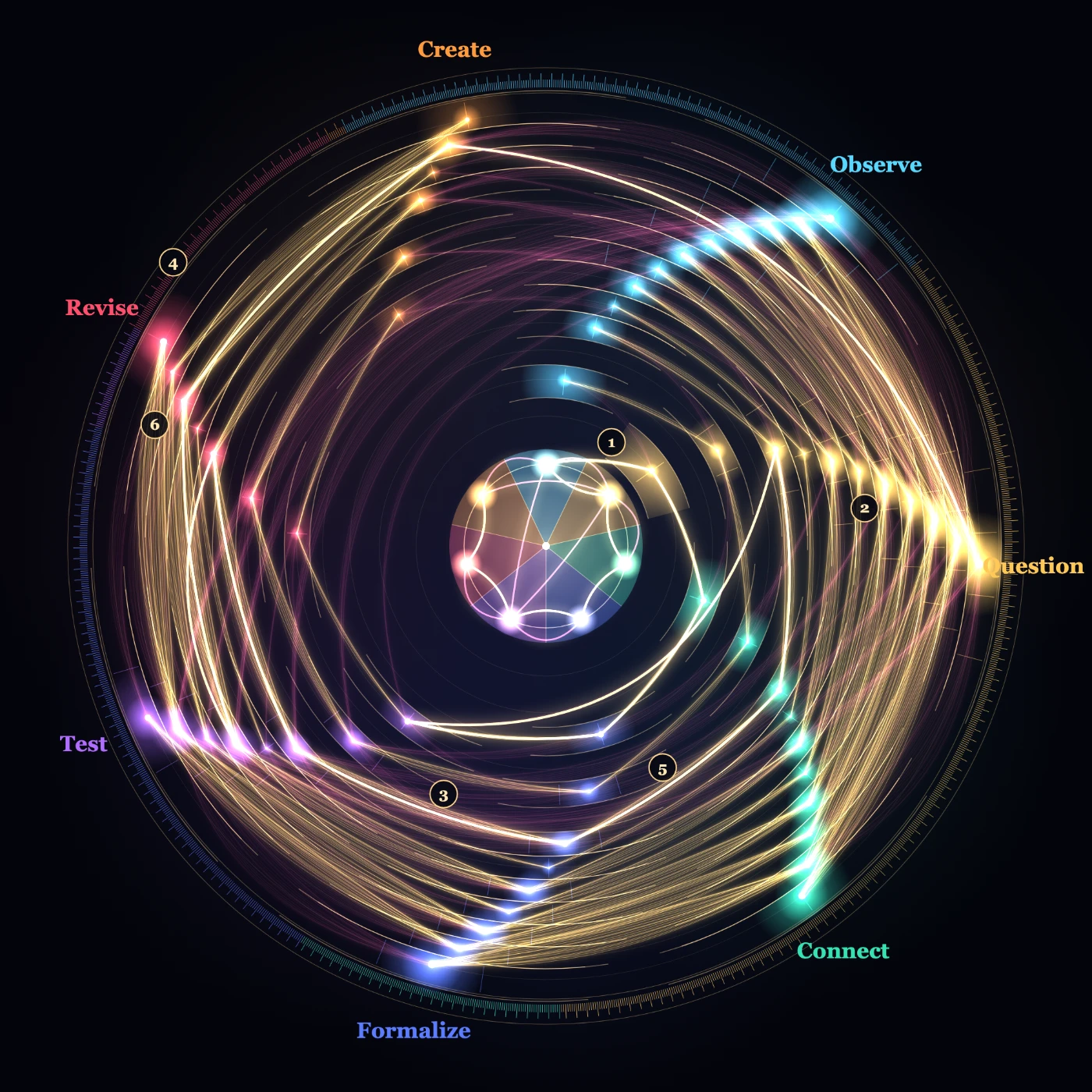
One question. Many possible paths. Seven inquiry actions and fourteen allowed transitions shape this drawing. Follow one inquiry through its central graph; the outer rings remain the complete static map.
The illustrated inquiry returns to Question after thirteen moves. Read its complete path and all six mathematical references below; motion is never required.
Six references connect the visible construction to its mathematics.
Ring k holds the inquiries of k moves from Observe: Nk(v) = (eO⊤Ak)v of them stand at move v. The rim counts all 1,370 inquiries of 13 moves. The key to markers ① to ⑥
Illustration An exact construction from the movement, Anavi’s design formalization of how it works on a question. It counts what the movement allows; it does not measure Anavi’s work, and it shows no product behaviour.
Authored, not computed: the rings’ radii and gentle twist, the colours, the glow and the frame.
The moving light follows the same thirteen allowed moves as the illustrated inquiry. Its central guide curves and timing are authored, not recovered coordinates from the original raster generator or measurements of Anavi’s work. The original drawing remains the static map. Previous and Next expose the same states without animation.
Start at Observe: one zero-move path. The counts below describe all allowed paths from Observe, not just this single illustrated inquiry.
I Purpose
Anavi LLC
Anavi investigates structure across systems, disciplines and scales—testing what survives translation, where the resemblance breaks, and what becomes possible when useful connections are made rigorous.
It begins with questions. It looks across boundaries without pretending the boundaries are meaningless. It tests correspondences against evidence and against difference, revises when they fail, and creates when something useful takes shape.
What takes shape may be research, a model, an experiment, a method, a tool, a visualization, software or a product. None of these is the boundary of the company.
A question.
A question often crosses disciplines before it belongs to any of them—before it becomes a research question, a model, an experiment or something to build. What happens next is not a pipeline.
Possibility.
What survives takes a form—one possibility among others, and the start of the next question.
Founder · AI product builder · Independent researcher
I’m Ash, founder of Anavi, an MBA candidate at Seattle University Albers School of Business and Economics, and a female veteran with a background in United States military intelligence. I earned my Bachelor of Science in Neuropsychology from Portland State University. I’m also a polyglot and an avid, many-faceted nerd, drawn to the connections between minds, languages, stories, science and systems.
More about Ash: the whole biography, questions and selected work →
II Projects
One thing that took shape.
A question about what a personal library could become is developing into a higher-order system for books, evidence, interpretation and inquiry.
In development; not release-ready.
Folium X formalization: three expressions from its own framework
Folium X is designed to keep a work, an edition of it and the copy on your shelf apart, and to give your copy its own history.
Design formalization in Anavi’s legend Folium X’s label: Design principle
The library as a graph. V is the set of vertices—books, passages, people and questions—and E the set of edges, the typed relations among them. E never stands for Edition, which is always written in full.
Design formalization in Anavi’s legend Folium X’s label: Structural correspondence
Φ, a constrained transformation: it takes the library’s state at one step, an input, and the constraints that apply at that step—such as provenance, identity, permissions, source fidelity, privacy, reader authority and epistemic status—and gives the state at the next step. An input that meets the constraints is applied; one that does not is refused, and the state is unchanged except for a record of the refusal. The principle that what must stay traceable stays traceable applies only to such admissible transitions, under their stated constraints, and to the claims that survive them uncorrected and undeleted—not to arbitrary updates.
Design formalization in Anavi’s legend Folium X’s label: Design principle
Defined in Folium X’s own framework, where it is canonical. It describes one product: it is not a model of Anavi, and Anavi’s other work does not inherit it. Each expression carries two labels that answer different questions. Anavi’s label says what kind of company claim it is: here, always a design formalization, our model of our own product. Folium X’s label says which particular claim Folium X makes with that expression. Neither is a confidence score, and there is no automatic mapping from one to the other. Its Φ is Folium X’s own symbol; it is not the standard normal cumulative distribution function Φ used in The discipline.
What Anavi is investigating now. A kitchen at 7:40, a word in its ancient world, a garden across the seasons. Each scene opens onto a question we are pursuing, the experience it might become, and the work still needed to bring it into being.
Give an agreement a visible record of fulfilment: photographs, notes and sign-off connected to the work promised.
Pilot built, not yet released

Carry each service update to the people who need it, and make their acknowledgement visible while there is still time to act.
Pilot built, not yet released

Encounter a word within the world that gave it meaning, and follow the evidence into a study of your own.
Early prototype
All 20 current inquiries, with their stages, topics and stories →
What takes shape: Research, models, experiments, methods, tools, visualizations, software, products, rejected hypotheses and analogies, nothing yet. What each means, with examples →
Working names. Illustrated possibilities, not product screenshots. The scenes use no personal data and make no AI-service requests.
III Research and principles
Different systems often share structures that disciplines name differently. Take two that seem unrelated—an ecosystem and an information network—and one structure that appears in both: feedback.
| Prey at the start | Prey over the cycle | Window at the start | Window after the first loss |
|---|---|---|---|
| 1.5 | 0.63 to 1.50 | 6 | 20 to 40 |
| 2.0 | 0.41 to 2.00 | 20 | 20 to 40 |
| 3.0 | 0.18 to 3.00 | 34 | 20 to 40 |
Predator and prey (Lotka 1925; Volterra 1926)
x is the prey population and y the predators; α is the prey’s growth rate, β the rate of predation, δ the rate at which meals become predators, γ the predators’ death rate.
Additive increase, multiplicative decrease (Jacobson 1988; Chiu & Jain 1989)
w is the congestion window: how much a sender may have in flight before hearing back. A loss is read as a signal that the path is full. The figure follows one sender. Chiu & Jain’s result concerns several senders sharing a link, under their model’s assumptions—among them, one bit of feedback that reaches every sender at once; there, additive increase with multiplicative decrease converges to an efficient, fair share.
And then it broke
But here the analogy fails.
Start the two systems from different places. The network returns to the same rhythm: after its first loss, the window swings between half the link’s capacity and all of it, from any whole-number start up to the capacity. Other starts can differ: from 2.3, the peaks after the first loss are 40.15, 40.075, …, and from 41 they are 40.5, 40.25, …; each overshoots the capacity by half the previous overshoot, so the window approaches that swing without ever reaching it exactly. The predator–prey cycle does not return: each starting point keeps its own cycle, larger or smaller, for ever.
V stays constant along every cycle of the classical model, so nothing pulls a cycle back to a standard size: its size is fixed by where it started. Established for the classical model
The difference is information too.
In these two models, and from the starts tested here, the break has a cause you can name. The predator–prey cycle keeps the size it began with because V is conserved; the window returns to the same band from each start because the link loses packets at the same point every time and the rule halves the window at each loss. That is not a general test. A cycle whose size depends on where it started does not, by that alone, have a conserved quantity, and a cycle that returns to one size from anywhere shows neither that someone designed it nor which mechanism brings it back. The failed analogy leaves a question to ask of the next system: what brings it back, if anything, and did anyone choose that?
Which model you translate matters. Give the prey a limit to their growth and the predators a limit to their appetite (Rosenzweig & MacArthur 1963), and the ecological model can settle into a cycle of fixed size too, with no designer: essentially every predator–prey model proposed by 1972 has either a stable equilibrium or a stable cycle (May 1972). The first break belongs to the classical model; the differences in design, signal and failure survive this refinement. Established
Tested here: “an ecosystem regulates itself the way congestion control does.” Speculative analogy It fails, and the failure is kept.
Some structures recur across apparently different systems. Choose one to see the domains where we record a claim about it, and what kind of claim each is. This is an index of places to look, not a checklist imposed on reality: where a structure is not drawn, no claim is made. Sources are named beside the entries they support; an entry without one is a definition, a standard result or method of its field, or a comparison of our own.
Every connection on this page is one of five kinds of claim: an established result, a structure shared by different systems, a model of our own work, a testable idea not yet adequately demonstrated, or a comparison sketched for thinking. They are kinds, not a scale: none is a rung on a ladder of certainty. Each has its own line and its own name. How well a connection is supported is a separate question, answered beside it: its sources, its scope and, where it has been tested, the result.
Established
This connection is established.
A recognized theorem, principle, mechanism or formal structure, used within its demonstrated scope and with appropriate assumptions.
One continuous line: a result documented in its own field.
46 in the constellation: Feedback · Mathematics; Feedback · Computation; Feedback · Biology; Feedback · Cognition.
Structural analogue
This is a real similarity; a shared mechanism has not been established.
Two or more systems exhibit a meaningful shared organization or relation, but equivalence or a shared mechanism has not been established.
Two parallel lines: one shared structure, in two systems.
12 in the constellation: Feedback · Organizations; Feedback · Design; Recursion · Cognition; Recursion · Literature.
Design formalization
This is our own model of our own work.
Notation or a model created to describe an Anavi system, product, workflow or research object. It may be mathematically coherent without being an established theorem about the world.
The construction line of technical drawing: a model we drew of our own work.
7 in the constellation: Recursion · Anavi’s own work; Relation · Anavi’s own work; Constraint · Anavi’s own work; Information · Anavi’s own work.
Hypothesis
This is a testable idea that has not yet been adequately demonstrated.
A proposed relationship or mechanism that is testable in principle but has not yet been adequately demonstrated.
A row of points: places where a test can land.
5 in the constellation: Emergence · Computation; Emergence · Cognition; Invariance · Language; Hierarchy · Cognition.
Speculative analogy
This is speculative.
An intellectually useful comparison with insufficient evidence for mechanistic or formal equivalence.
Long, open strokes: a comparison sketched for thinking.
2 in the constellation: Uncertainty · Anavi’s own work; Agency · Computation.
Kind and support are separate questions. A claim is relabelled only with evidence, a stated scope and a recorded reason, and the new label names a different kind of statement; it is not a promotion. On this page one analogy was pushed until it broke, and the failure is kept—see What survives translation?
Folium X, one thing that took shape here, labels its own claims in its own terms: design principle, established theory, structural correspondence, implemented mechanism and exploratory hypothesis. Anavi’s five kinds classify the company’s claims; Folium X’s labels name the particular claim made about the product. Neither set is a scale, and there is no automatic one-to-one mapping between them—see Folium X.
Research does not always lead to a product. Sometimes it leads to a better question, a model, a rejected hypothesis—or to nothing yet, which is recorded too.
Research can lead to a better question or a rejected hypothesis or a model or nothing yet
Questions pursued for their own sake, with their sources kept.
A structure stated precisely enough to be tested.
The classical predator–prey model, tested above
Folium X’s formalization
A test that could have gone the other way.
A way of working that can be used again.
Instruments for other inquiries.
Evidence-Guided Decipherment · Early prototype (research tool)
Figures that carry an argument, each with a text equivalent.
Working code, checked against what it claims.
Software offered to people, when it is ready.
Ideas that failed their test, kept because the failure taught something.
An ecosystem regulates itself the way congestion control does
A shortened title meant the book was not owned
Inquiries that have not produced anything. They stay open, and on the record.
The discipline
How Anavi keeps its claims honest: what it assumes, what would show it wrong, what it leaves open, and how it changes its mind.
Read the whole discipline: every section, the theory map, figures and formulas →
IV Next step
Tell me what caught your attention: a question worth pursuing, a difficulty you know intimately, or a possibility these projects have not yet imagined.
The Orbit above is a Möbius band: its generator draws the surface ((158 + v cos ½t) cos t, (158 + v cos ½t) sin t, 1.25 v sin ½t) for v in [−70, 70] and t in [0, 2π], so the end joins the start with v reversed. The surface has one side and a single boundary curve. Carry a small arrow that points across the band—at right angles to the centre line—once around, and it returns pointing the other way: local orientation reverses after one circuit. We read that as an image of the loop—work that returns to its question changed—not as a proof of anything.
Established the geometry of the band Speculative analogy our reading of it
A question.